March Madness Brackets
By Lily Foster, Molly Connelly, and Cameron Thornton, Print Opinion Editor and Staff Writers
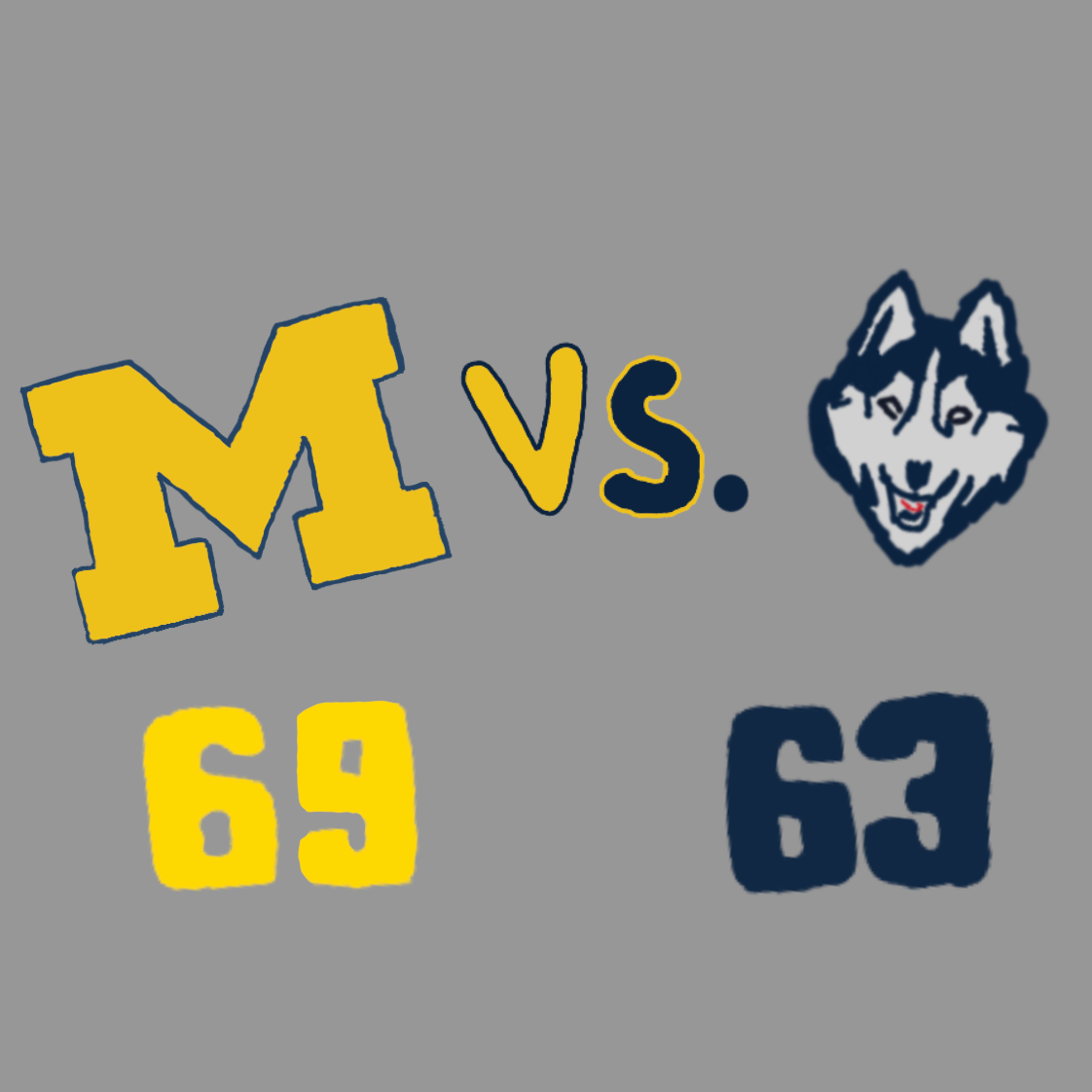
Graphic by Gavin Lee and JP Birdwell, Graphics Members
Men’s Brackets
This year’s men’s National Collegiate Athletic Association (NCAA) tournament showcased the dominance of multiple frontrunner programs, but nevertheless succeeded in delivering arena-shaking moments, bracket-ruining upsets, and inspiring storylines. The University of Michigan (U-M) Wolverines came out on top, earning their first NCAA championship since 1989 and the program’s second title in its history.
Some of the top seeds, such as the University of Arizona (U of A) Wildcats and U-M, proved to be dominant, providing consistent blowout wins at unprecedented levels. The Wildcats’ average margin of victory was 20 points until U-M eliminated them in the Final Four. Similarly, excluding the championship game, Michigan won by an average margin of 18.75 points, including an 18-point win over fellow number one seed Arizona.
The other two number one seeds, Duke University (Duke) and the University of Florida (UF), did not fare as well, with both teams eliminated earlier than expected in unpredictable end-of-game situations. The UF Gators were upset by the number nine-seeded University of Iowa (UI) in only the second round of the tournament, losing by one point after the (UI) Hawkeyes hit a three-pointer with less than five seconds on the clock.
Perhaps the most talked-about moment of the tournament was the end of the Duke versus University of Connecticut (UConn) game, in which the Huskies’ prowess in the final moments, and crucial mistakes by the Duke Blue Devils resulted in Duke's elimination in the Elite Eight. Despite the Blue Devils maintaining a lead for the vast majority of the game, the Huskies clawed back from a 15-point deficit in the second half, bringing the game within one possession with less than a minute remaining. Up by two points with ten seconds remaining and possession of the ball, Duke’s position looked promising. However, after inbounding the ball, point guard Cayden Boozer turned over the ball in an attempted pass downcourt. With less than five seconds on the clock, the Huskies got the ball to freshman Braylen Mullins, who hit a shot from the logo, sending UConn to the Final Four.
Other notable upsets included the University of Wisconsin’s first-round loss to twelfth-seeded High Point University, and eleventh-seeded University of Texas at Austin’s (UT Austin) wins against Brigham Young University (BYU) and Gonzaga University.
Graphic by Cara Hamilton, Head of Illustrations
Women’s Brackets
The women’s bracket proved initially predictable, but upsets occurred in every round of the tournament, leaving no perfect brackets by the Sweet Sixteen.
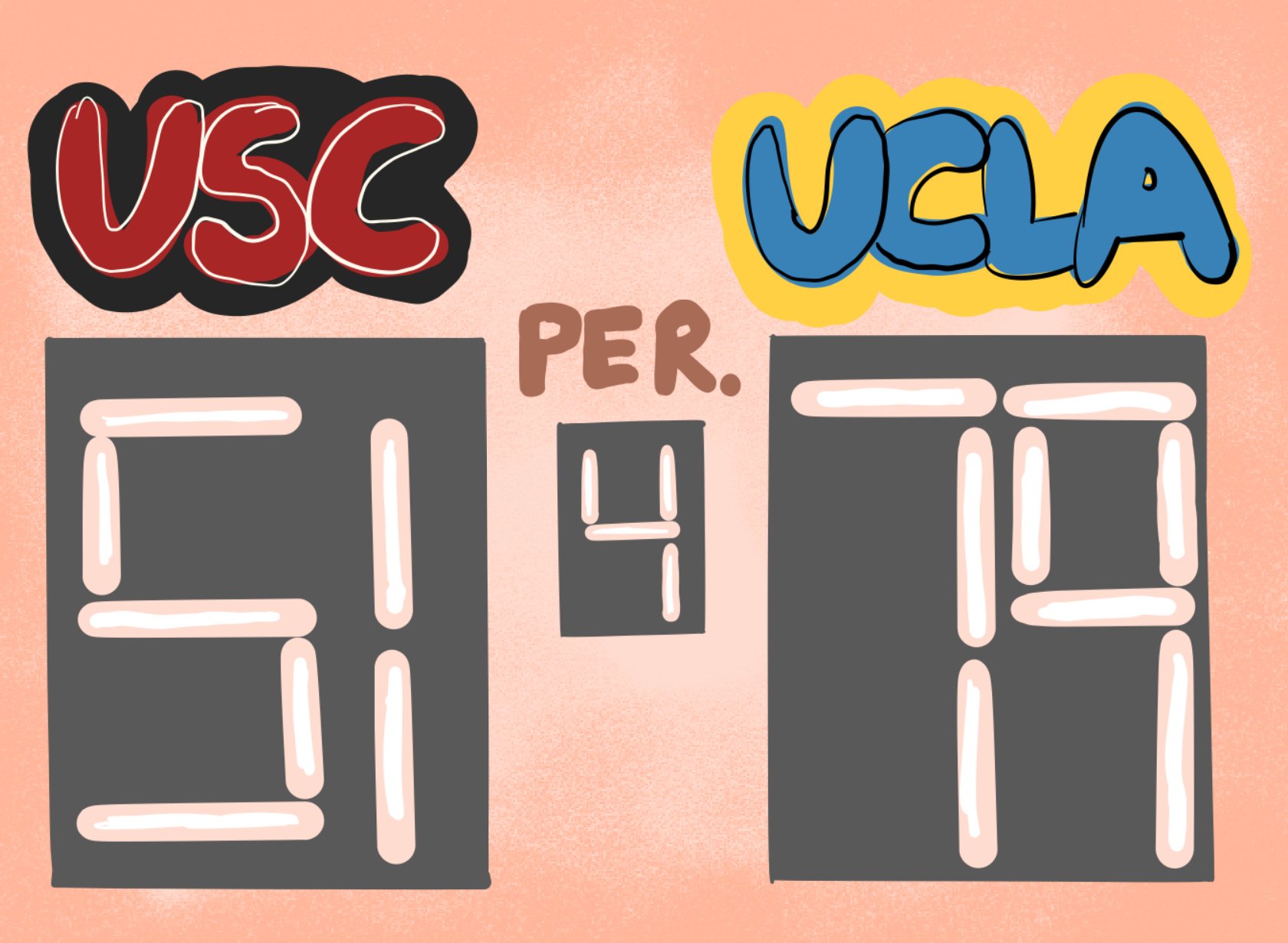
The number one-seeded University of California, Los Angeles (UCLA) Bruins won the tournament in a dominant 79-51 fashion versus fellow one-seed University of South Carolina (USC), marking the third-largest margin of victory in a championship game in tournament history.
The road to the Final Four included strong performances, with three-seeded Duke hitting a buzzer-beater to upset two-seeded Louisiana State University in the Sweet Sixteen. Tenth-seeded University of Virginia also beat out second-seeded UI on Iowa’s home court to advance to the Sweet Sixteen.
All four number-one seeds, UConn, UCLA, UT Austin, and USC, had dominant performances in their first four games. This marked just the fifth time in history that all four number-one seeds were in the Final Four, and the exact same four as last year's finalists.
Starting from the tip-off, UConn, favored to win by about 65 percent, versus USC, the game proved to be a physical and low-scoring battle, leaving UConn coach Geno Auriemma and USC coach Dawn Staley unhappy in their televised mid-game interviews. UConn stars All-American Azzi Fudd and National Player of the Year Sarah Strong both struggled offensively in their 62-48 loss.
The story of the tournament, however, proved not to be the game, but rather the altercation seen on the broadcast between Auriemma and Staley, in which Auriemma accused Staley of not shaking his hand prior to the game. The two had to be physically separated from one another, and Auriemma stormed off the court. Auriemma issued a public apology on social media the following day, and the two have since reconciled, but Auriemma also received backlash from former UConn Huskies, including Breanna Stewart and Sue Bird, for his behavior.
UCLA versus UT Austin also quickly became a physical, defensive battle with both teams struggling to score. The UCLA Bruins maintained a lead throughout the game, and the defensive prowess of 6’7” center Lauren Betts helped the Bruins get the 51-44 win.
Despite their Final Four offensive struggles, the Bruins came out swinging against the USC Gamecocks and maintained a double-digit lead throughout most of the game. Gabriela Jaquez’s 21 points and ten rebounds, and Betts’ 14 points and 11 rebounds, which earned her Most Outstanding Player in the Final Four, helped propel the Bruins to victory for their first-ever championship in the NCAA era.
Seniors scored every single point in the Bruins’ final two games, and a record-setting six went on to be drafted to the Women's National Basketball Association the following week. The tournament proved highly successful for both Bruins fans and the 13 percent of Entertainment and Sports Programming Network (ESPN) brackets that predicted a UCLA championship.
Acalanes’ Brackets
The Class of 2028 held a March Madness bracket tournament to create competition for sophomores throughout both of the NCAA tournaments. Sophomore class officers put together and promoted the competition before the tournaments took place.
“We had a few different ways to publicize [the competition],” Sophomore Class President Jack Roberts said. “We got a lot of information out on Instagram Reels and Stories, and then we made a lot of posters. We also advertised a lot by word of mouth.”
Stakes were high between participants, as the winning bracket holders for each tournament received a JBL speaker.
“I had a lot of confidence that U-M would win, I just went with my instinct,” men’s bracket winner and sophomore Owen Blanchard said.
Students became interested in the sophomore tournament, as March Madness bracket-making has been an annual tradition for many.
“The tournament is always really fun to watch, and I look forward to making my predictions every year,” Blanchard said.
Overall, the competition brought out the sophomore class spirit.
“Friendly competition is always a good thing in my eyes. It makes us more bonded and improves relationships,” Roberts said.